Mug Rug
While waiting for the tapestry frame loom to arrive, I wove this little (5″ x 5″) coaster thingy. The center area didn’t end up matching what was in my imagination. Oh, well!
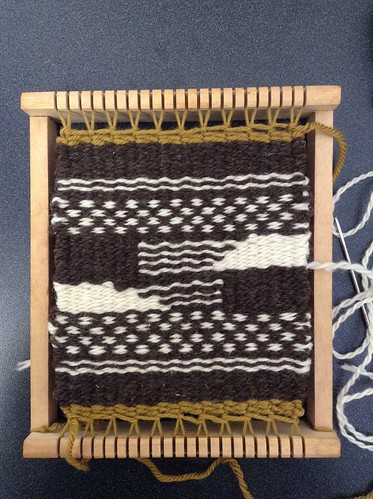
While waiting for the tapestry frame loom to arrive, I wove this little (5″ x 5″) coaster thingy. The center area didn’t end up matching what was in my imagination. Oh, well!
Mini tapestry number four. This one became a convenient pillow when a kitty and a sunbeam crossed paths.
I played around with textures this time around.


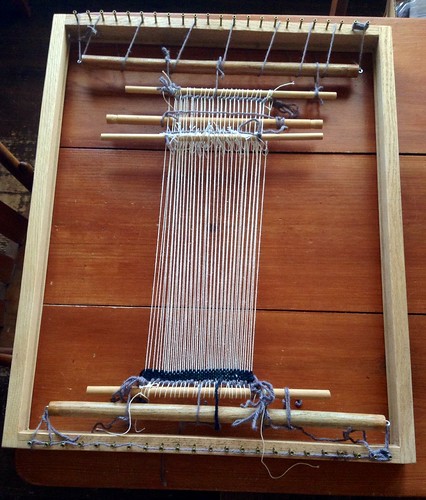
After following instructions from Navajo Techniques for Today’s Weaver by Joanne Mattera (1975), I assembled a small Navajo-styled loom. The frame, about 2′ x 3′, was $2 at a junk shop. I think it was meant to be for rug twining because the nails are spaced 1″ apart. I’ve never used it, so it was nice to give it a job. A few of the nails came in handy as I used to them to secure dowels or create tension by wrapping the twine and tying it. Making a loom like this is similar to creating a backstrap loom. It looks fairly simple. There are some sticks, some yarn, etc., but when you look at each piece individually, you realize they each have a very specific job to do, and so you need to put your brain to work to understand how one area is connected to another.
The neat thing about a Navajo loom is that you don’t have fringes when you’re finished. This appealed to me. However, to get that tidy edging, you need to first warp the loom, then twine the top and bottom threads for spacing and securing, and then transfer the warp off the warping dowels and bind onto a second dowel. I failed with both the twining and the binding, My warp threads are too close to each other plus they’re lifting off the second dowel on the edges. My motto: live and learn.
Well, I didn’t spend a penny but I now have a little setup that can be used and improved.
If you’re interested, there are plenty of examples out on the Internet with plans on building more solid Navajo looms:
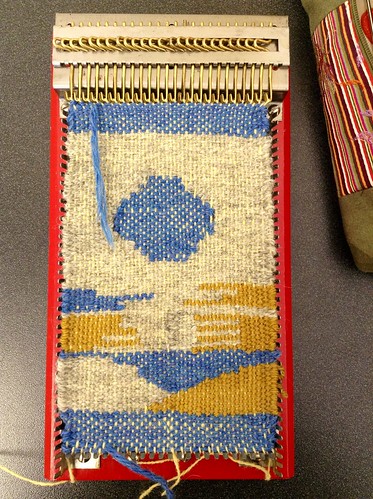
The Lightning Weaver, yet again, stood in as a tapestry loom as I tried to weave the second sampler from Nancy Harvey’s book, yet again. Because the set is 12 dpi, I need to find the perfect weft size/type to make this loom actually work well. So far, I’ve chosen knitting yarns and embroidery floss and most are too “spongy” to pack down well. I think the yellowish-brown in this sampler is probably the closest to a good tapestry wool that I have, and I don’t have much of it. I’d love to be able to buy a sampler kit of a variety of rug weaving colors to have on hand.
What I learned this time: I can weave all the way to the top and the bottom if I don’t mind it being packed loosely and if I have a lot of patience; I have lots of trouble where two colors join if they’re increasing or decreasing (note the warp threads showing); and circles are difficult. Because this circle started leaning toward being hexagonal, I said, “Go for it, circle! Be what you want to be!” So, there’s a hexagon in the center where a moon or sun was supposed to be.
I’m done with sampling for awhile. I’m considering weaving a thin band to make a cuff bracelet. I’ve also got a sturdy frame at home that will work, I think, as a Navajo-styled rug loom if I can wrap my brain around how to warp it. So far, I’m learning all of this from the great books of the 1970s and 1980s. Nancy Harvey’s tapestry books are really good, and now I’m studying Navajo Techniques for Today’s Weaver, by Joanne Mattera (1975).