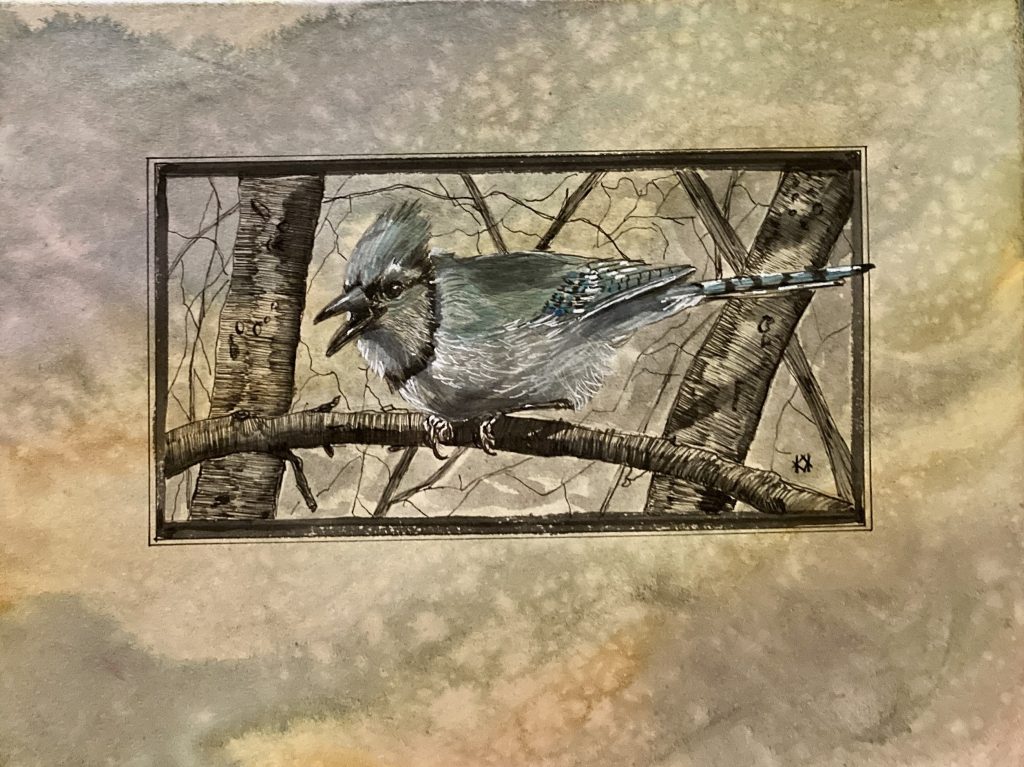
9″x12″, ink and gel pen on Stonehenge Aqua hot press watercolor paper.
This Blue Jay was calling over and over in our crab apple tree the other day. I could hear another answering back from across the neighborhood, and I don’t know if they were telling each other about the food at the feeders or if they were saying hello or if they were saying stay away, these peanuts are all mine.
I nearly gave up on this drawing after realizing I had made the bird too big for the frame, which I had already drawn in pencil and it wouldn’t erase. After considering it for a day, I simply let the tail push past the lines. I also went a little bit overboard on the white gel pen, which I can’t seem to give up with ink drawings.
Like many artists who use water media, I’ve developed a persistence in searching for a way to display finished works without using glass. There are some clever and complicated ways of doing this like adhering the paper on a wooden panel, then fixing it, sealing it, etc. I gave that a try a few times, but I found the process fraught with error (on my part). So many steps equals so many opportunities for mistakes.
Recently, I was thinking about how much I like working on smooth surfaces, and I recalled that Ampersand Claybord is actually made for inks. And, conveniently, I just happened to have eight 6″x6″ panels waiting for a project. So, here goes–a new series of critters and perhaps botanicals on Claybord. Once I’m done, I can use a fixative spray and perhaps a varnish and then they can be mounted in a frame without glass. Very cool. You’d think I’d remember this because I did a series of Claybord ink and colored pencil drawings and paintings a few years ago, and they’re still on my wall. But yet again, I’m reminded of how often I need to relearn the same lessons.
One truly unique thing about Claybord is you can scratch out highlights, one of the most rewarding parts of using it, and it solves one of the most frustrating problems about Claybord, which is how liquid pools and can leave hard edges. Take out the exacto blade or the fiberglass brush and viola! Problem solved.
And why not celebrate them? There are several dozen species in this country, but I’m only representing three here. Although they may be overlooked for their flashier friends, I find them charming. The conical beak, the blocky head, the brownness of them… what’s not to love?
I like how they hang out together in bushes and seem to enjoy each other’s company. They’re easy to take pictures of because they’re fairly tolerant of camera-toting artists and hold still a little longer than some small birds (I’m talking about you, warblers). So I say, let’s celebrate the humble sparrow, my steady, backyard friend.
I had five sheets of 7”x10” Arches hot press watercolor paper, and I was in a mood to use fountain pens to practice some line techniques. I’ve recently been inspired by some of the great pen and ink artists from the golden age of illustration, in particular Franklin Booth. I purchased a new book about him called Franklin Booth: Silent Symphony. He was an amazing artist.
My sloppy hatching is nothing to write home about, but it’s really fun to do—challenging, too. I set out to sketch small birds using more line work and less color except for my favorite moody background, but I didn’t always succeed—and I relied on gel pens for highlights in all of them.
The Junco sketch looks more like a painting. All of my initial hatching was covered up when I lost confidence in what I was doing. Still, I like all five of these.
I particularly like this first one I completed, the lone sparrow on the sunflower. I think the simple colors and composition of this are a pleasing combination.