Oct 27, 2012
At the largest setting, 7′, the Dewberry Ridge Triloom fits in my work space (just barely).

At the largest setting, 7′, the Dewberry Ridge Triloom fits in my work space (just barely).
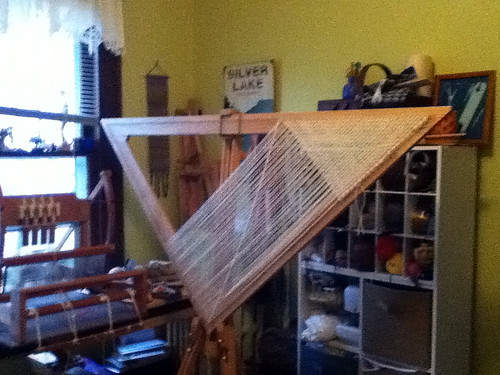
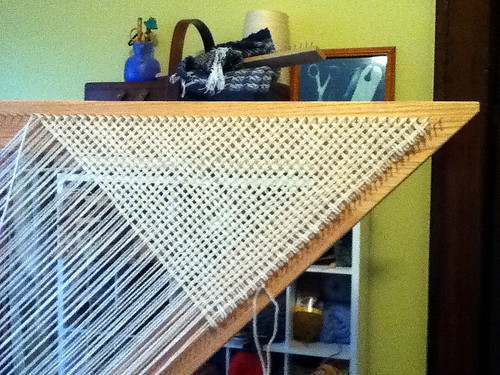
Better pictures to follow, I promise. (What can I say that? My little iPod, with the blurry camera, is being upgraded, and the new camera is the same as the iPad, which means I can stop apologizing for my blurry, dark, and pretty much terrible pictures. Yes, I have a regular camera… but the iPod is so darn convenient.)
So, I came home yesterday to find my beautiful new Dewberry Ridge modular triloom on my doorstep. When I opened the box, I was pleased to see how secure everything had been sealed up. The wood is just lovely, and the whole loom is sturdy and something I’ll use forever. Gary McFarland, the loom maker, had also included some basic weaving instructions and a guide to assemble the different loom sizes. The pieces attach together with a bolt with a tiny gear on the top. You set the bolt into a notch and it pulls together two pieces, and then you use a hex wrench to tighten them together. Clever!

My husband dared me to have the loom unwarpped and assembled in 15 minutes (he set a timer), and I didn’t even have to rush. I not only had all the individual pieces lined up on the table and the loom assembled into the smallest size (3′), but I also pulled out my easel, set it up, and had the loom ready for weaving with a few minutes to spare.
But I couldn’t leave it at 3′ knowing I had all those extra feet available, so I surveyed my yarn stash, checked a yardage chart for how much yarn I’d need for different sizes, and changed the loom to the 5′ size. I chose some really beautiful homespun wool I found at a thrift store–1,500 yards worth! I also chose to weave a continuous bias pattern. I’m planning on felting the tri when I’m done with it… I am still undecided what it should be, but I’m leaning toward a little shawl with some buttons on the front.
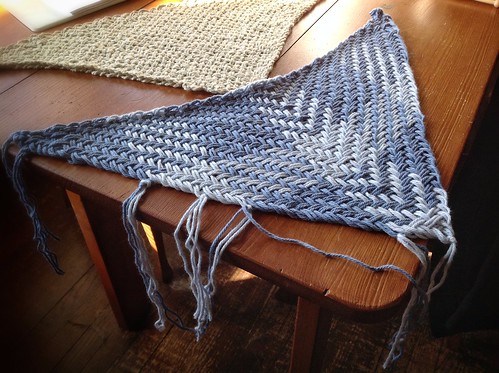
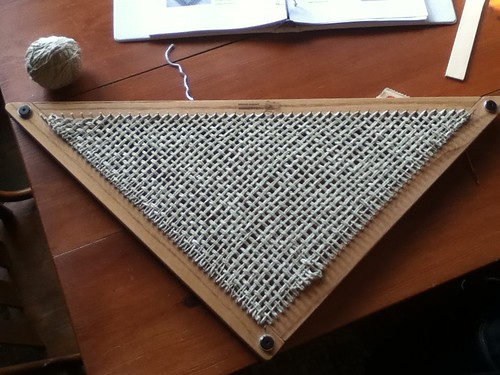
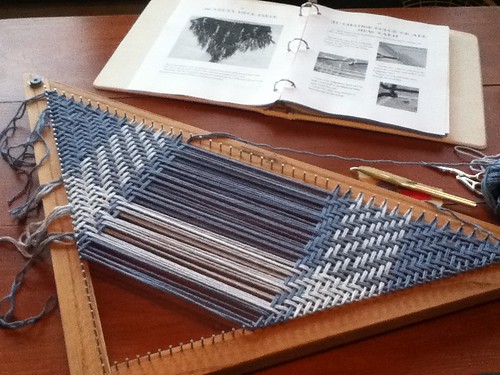
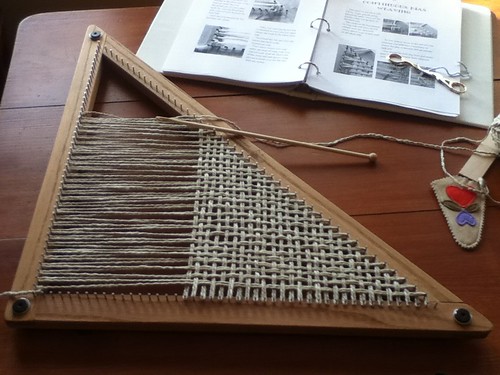
I spent some time learning some new weaving techniques on the little Hideaway Homestead two foot triloom. I practiced 2×2 twill, with color changes, and I also learned how to weave on the bias, which creates a nice drape.
Quite awhile ago, in fact nearly three years ago, I posted what I thought was an impressive list of all the little weaving and knitting looms I had accumulated up to that time. It was just about then I started becoming interested in weaving, and I was making a pretty clear switch from knitting to weaving. I still do an occasional knitting project, but most of my time is spent in weaving world. So, maybe it's time for an updated list? I think it's interesting that all of the looms from my old list could have probably been stored in one medium-sized plastic bin, but I still thought it was excessive.
Then:
Now… (I've kept every one of those, plus added a few.)
Okay, we've gone way past the medium plastic bin storage idea!
For some reason–and not just because I'm running out of room in my tiny 8'x9' office–with the recent purchase of the 7' triloom, I feel I've actually come full circle. The first looms I had an interest in were the 4" square looms and the little Wonder Weave rigid heddle loom. I then bought my first triloom. Little did I know that those simple looms would teach me the basics of weaving. From there, I let things slide, weaving-wise, until the next fall, about a year later, when I suddenly had an urge to buy a "real" loom. But first, with my inquisitive nature and with some helpful words from a Ravelry weaver, along with Laverne's fantastic series on backstrap weaving at Weavezine, I put together a backstrap loom (and chiseled my hand in the process!), and figured out lifting patterns for plain weave, weft-faced projects. It was about five months later that I bought the Emilia loom.
My looms, every one, are still portable and small enough to fold up and store on a shelf or under the desk. So, my little saying on the top of my blog, "weaving and knitting on small looms," still holds water. (Do I sound a little defiant?) And yet, I think I really started weaving because I wanted to follow the fibers visually and figure out how structure was created. If you've ever seen a triloom, you'll know the weaver walks the yarn from side to side, hooking it onto opposing nails and weaving over and under the horizontal threads that are created in the process. It's called continuous weave, where the warp and weft are woven at the same time. It's not fine weaving with silken threads, but it suits me. (And if I want to use silken threads, well, I just fire up the little Louet W30!!)
With all that said, I have two looms in the mix that will probably need new homes, the Peacock and the Kessenich. Both also need some work, but I'll post more about that in the future if I decide to wave goodbye.