Author: horsenettle

Mini Tapestry

No Comments

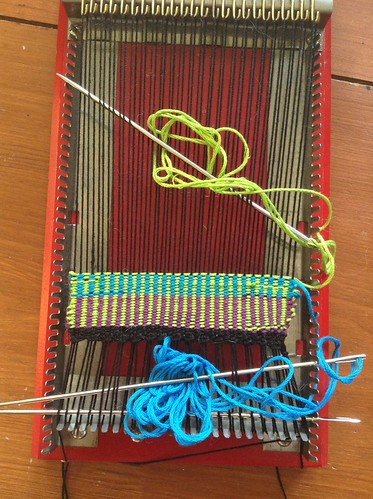
This time I used the Lightning Weaver with an crochet thread for a warp. I hemstitched the ends, and now that I’m done I realize I could have moved each end closer to the hooks to give more weaving room. The weft is embroidery floss, probably too thin, but that’s okay. It’s bright and lively. Off the loom, this teeny rug measures 3.5″ x 3.5″ not including fringe. It took about four hours!

Things I learned from this project: my weft was too fine for the warp and lead to having to beat each row too much; color changes make for fun, interesting weaving; my left selvedges are far tidier than my right (but I’ve always known that).

Mini Tapestry

Mini Tapestry

Mini Tapestry

Mini Tapestry Samplers

No Comments

Some experiments work out, and I post them here. Others are pretty cringeworthy, and photos are never shared. Here’s a case where I could have skipped this post, but something is telling me to share. Why? I’m suddenly crazy about tapestry weaving, and even my amateur attempts make me happy.

I checked out Nancy Harvey’s book, Patterns for Tapestry Weaving and wove both samplers. The first was done using the ever-awesome Lightning Weaver. It’s small but mighty.

The second was on the Authentic Knitting Board plus extenders. Best left for projects without curves, so I’ve learned.

Anyway, I spent the weekend weaving two samplers that technically should have been double or triple the size. My neck hurts from hunching over, and I didn’t get enough fresh air or sleep. Great fun, I say!

20140202-183835.jpg

20140202-183846.jpg

Lightning Weaver

5 Comments


It’s amazing. I finally own a Lightning Weaver.

Lightning Weaver

Is this the ultimate small loom? Could it be?

Lightning Weaver

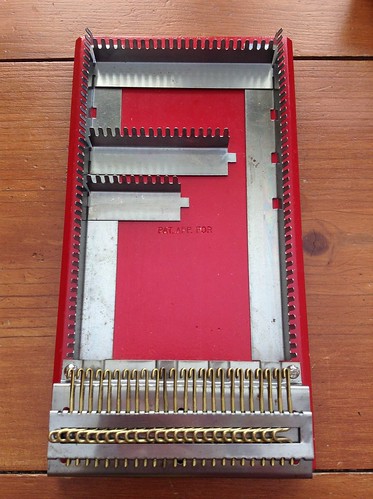
Not only is it cute, it’s a cheerful, cherry red. How neat is that?

Lightning Weaver

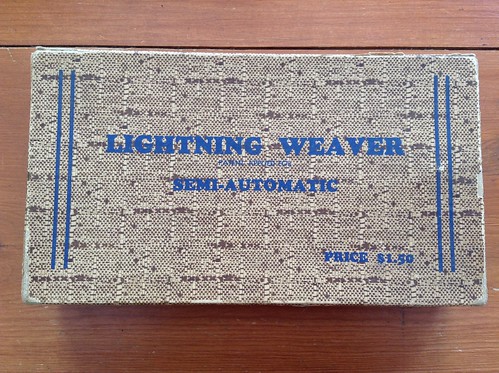
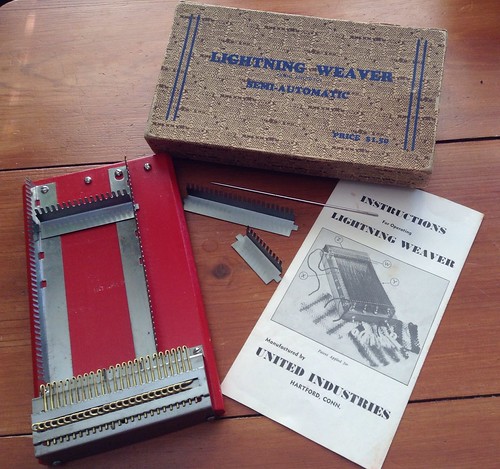
As the box declares, The Lightning Weaver once sold for $1.50. Nowadays, you’ll be lucky to find one on Ebay, and it’ll cost more than a few dollars. This loom is in perfect condition. It has all the parts, meaning it can be adjusted to 12 different sizes of squares or rectangles, the smallest 2″x3″, and the largest 4″x6″. It warps from top to bottom, and then the weft is woven more like a typical loom. This little loom has rotating hooks on the bottom, however, which allow the weaver to pass the weft through. No “overing” and “undering” like with a Weave-It. Just push the needle through the shed. After you get the weft in place (which does, I’ll admit, take a little practice), you’ll have the fun of changing the shed. This happens by running your thumb over the bottom hooks and clickity-clickity-clickity they all shift the opposite direction, bringing up the lower threads and lowering the top threads. New shed!

I’ve found I can use a variety of yarns, too, as I can skip every other hook with thicker yarns, so it’s even more versatile than it seems. And it was already pretty versatile.

Lightning Weaver

This loom was on my wish list for a few years now, but I’ve only seen one “junior” come up for sale. (FYI: The Jr. Lightning Weaver is not adjustable.) Because it was on my recent searches in Ebay, my husband noticed one come up for sale. I was sleeping at the time, so imagine my surprise and delight the next morning when he cautiously said, “Did you want a loom called the Lightning Weaver? Because I bought it for you.” Did I! Now, imagine my extreme surprise and delight when it arrived in perfect condition (seriously, was it even used?), with all the parts, the box, and the directions. Golly!

Lightning Weaver

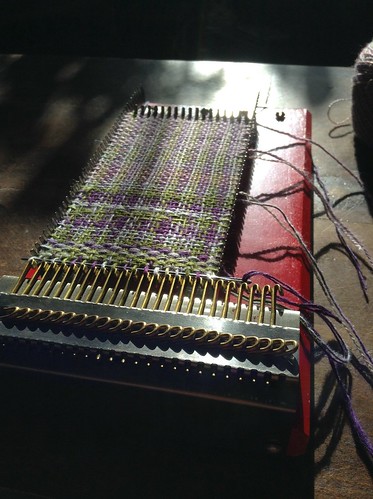
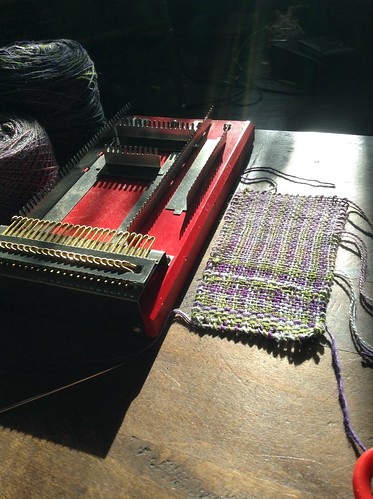
I’ve woven a few bits and pieces to get the feel for it, and then I recently found a great use for it: sampling. I sampled some silk one-ply yarn as the warp and used three different wefts to see what would happen. The top section was alpaca, the middle, a second silk, and the lower the same silk as the warp. I learned that the alpaca kept its form fairly well, although I didn’t care for the color combination. The middle silk gave me the most pleasing look, although I didn’t care for the overall texture, and the bottom silk, although interesting, didn’t stand out to me as something I’d like to wear as a scarf. So, it was a valuable thing to do before spending time warping up a bigger loom with enough to weave a scarf. For now, I’m setting the silk aside until inspiration hits.

But will I set aside the Lightning Weaver? Never! It’s a charming loom that is clearly a tool to be used.

Lightning Weaver

Twill Wool Scarf

No Comments

Twill Scarf

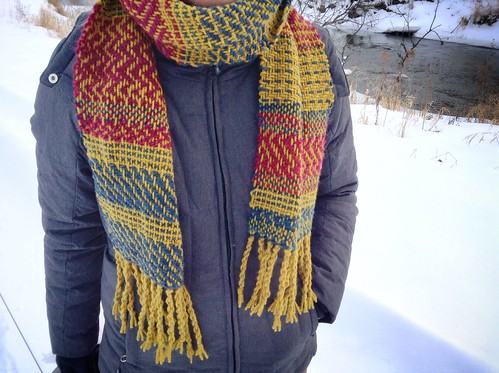
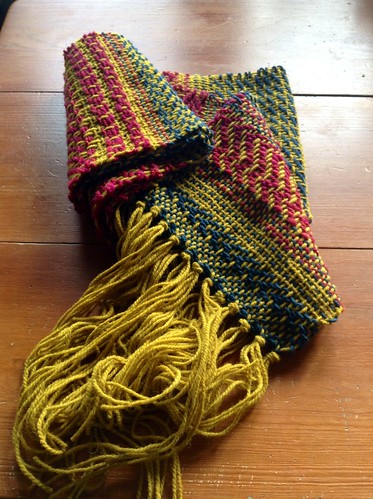
A few weeks ago, I visited Avalanche Looms and came away with this locally-produced wool. The yellow was dyed with goldenrod, the blue indigo. I discovered an unused hank of red in my stash, too, which was also a local yarn, and so I put them side by side on the table and thought, “Maybe.”

Twill Wool Scarf

For this scarf, I used a 10 dent heddle on my Ashford folding table loom, and I skipped every other slot to make it 5 dpi. Just for fun, I wove a bunch of different twill patterns and some colorful plain weave stripes. I’ll admit, when this was on the loom I wasn’t certain what to think of it, especially because, once again, I forgot that a floating selvedge can be a friend. Off the loom, washed, dried on the radiator, and with the fringes twisted, I suddenly liked it. A lot! It’s my happy January scarf, something that adds a splash of color to the wintry world.

Moral of the story is to weave with wool. It’s always fun. I really like wool. And the local flavor makes it even more delightful.

Goldenrod