I went all out and splurged on the 24 set of Derwent Graphitint pencils and the painting set of 12. I love the moody colors. I watched a Mind of Watercolor video and agree with Steve that the painting set mislabeled Russet—it’s actually Sage. More splurging: a three-pack of Molotov water brushes, a Croquis sketch pad, and three Fabriano watercolor sketchbooks.
Once again I traveled to the Heyde Center for the Arts to take another three-day Allan Servoss workshop, this time in watercolor.
His watercolor work is amazing, and I left with a better understanding of design and color as well as a creative process that feels refreshing and, well, creative.
He had five main lessons with paintings that got progressively more challenging. We moved from brushwork to shape to negative painting, the entire time discussing color choices, paper, brushes, etc.
Notice the turtle in the painting above? I couldn’t help adding it. I could see a turtle so there it is.
The painting below of the ravine ended up being the one I did quite a bit of work on when I got home, and as a result, it looks as much like a drawing as a painting. I gave in and tuned to watercolor pencils for the details that I just had to add—tree trunks and roots and more trees.
We also had a chance to try painting on a varnished, textured surface. The paint sticks in a different manner, more like Yupo. For this project, we did our own designs, and I ended up with birds and a busy background. No surprise there.
It was a great workshop, and I am once again fascinated with watercolor.
My reference photo was blurry, taken in low light after the sun went down. Instead of putting in a detailed background and adding a lot of contrast to the deer, I kept everything soft.
Honest-to-goodness watercolor, something I set aside years ago in favor of pencils and fountain pens. I’m getting ready for a watercolor workshop, so I bought a few new brushes, some M. Graham watercolors, and tried a new paper, Canson rough. I think the break was needed. I’ve spent a lot of time sketching and taking a design course in embroidery, and I have a different process than before. It’s funny how much I enjoyed painting these deer, but using a brush! That will take some getting used to.
The truth is, only on occasion do I use fountain pens with sharp line work. Most of the time, my pen and ink sketches look like watercolor.
Pen and ink in a Strathmore 500 sketchbook. This is a rooster who lives at our new boarding stable. He’s a friendly fellow. Monochromatic but still watercolor-ish. Pete, drawn with Monteverdi Blue Azure and the amazing Sailor Realo with a Zoom nib, my all-time favorite pen.
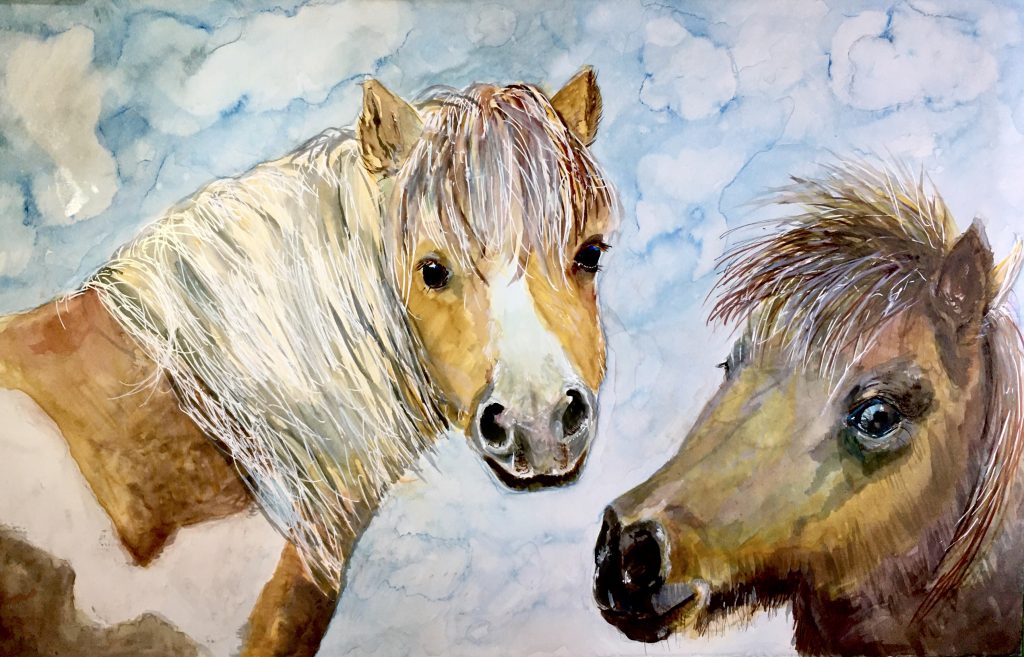
This is the second 18”x12” painting I’ve done lately, which is big for me. I drew/painted theses two ponies on Terraskin mineral paper
Using India ink has been eye opening. It’s lightfast, permanent, and waterproof. It’s available in many colors, and it’s mostly transparent. It can be a stick, liquid in a bottle, or markers. I guess I never thought about how perfect it is as a medium.
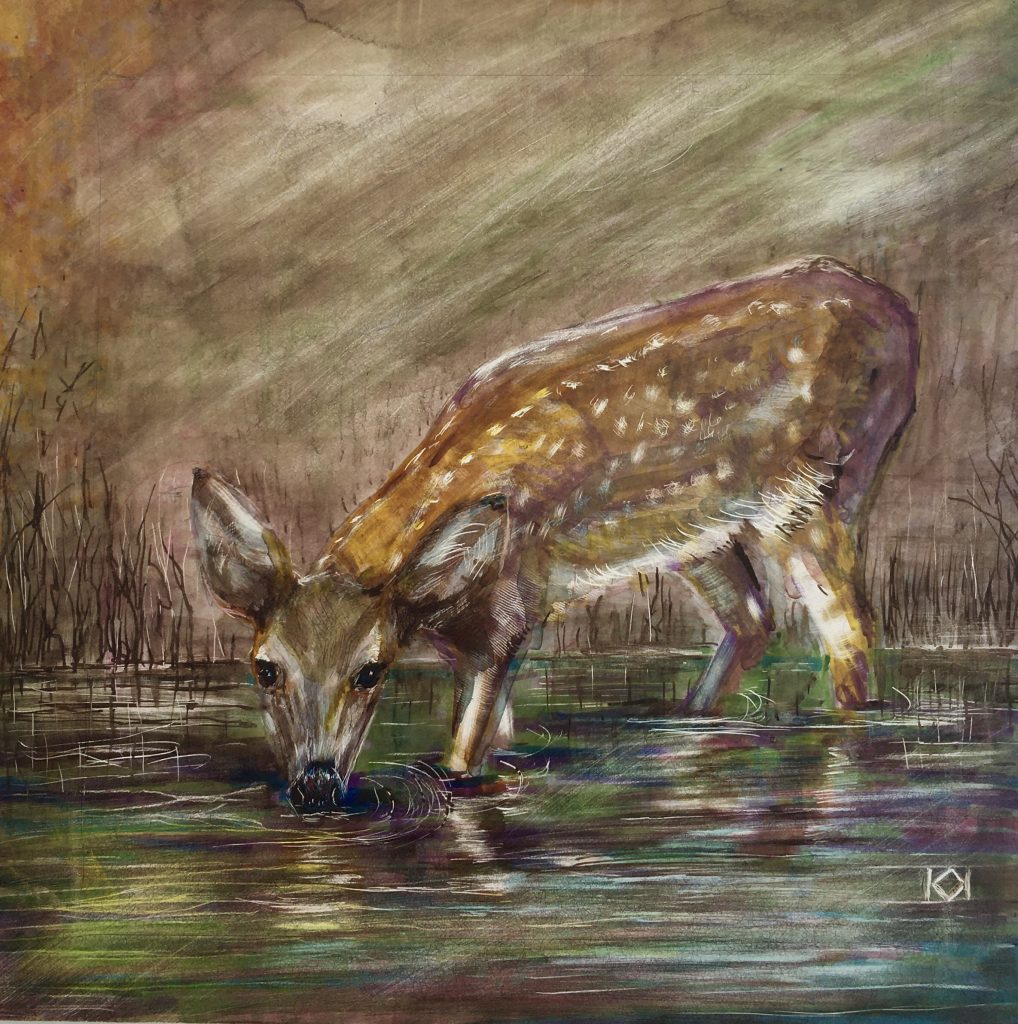
This little fawn is on Ampersand Claybord.
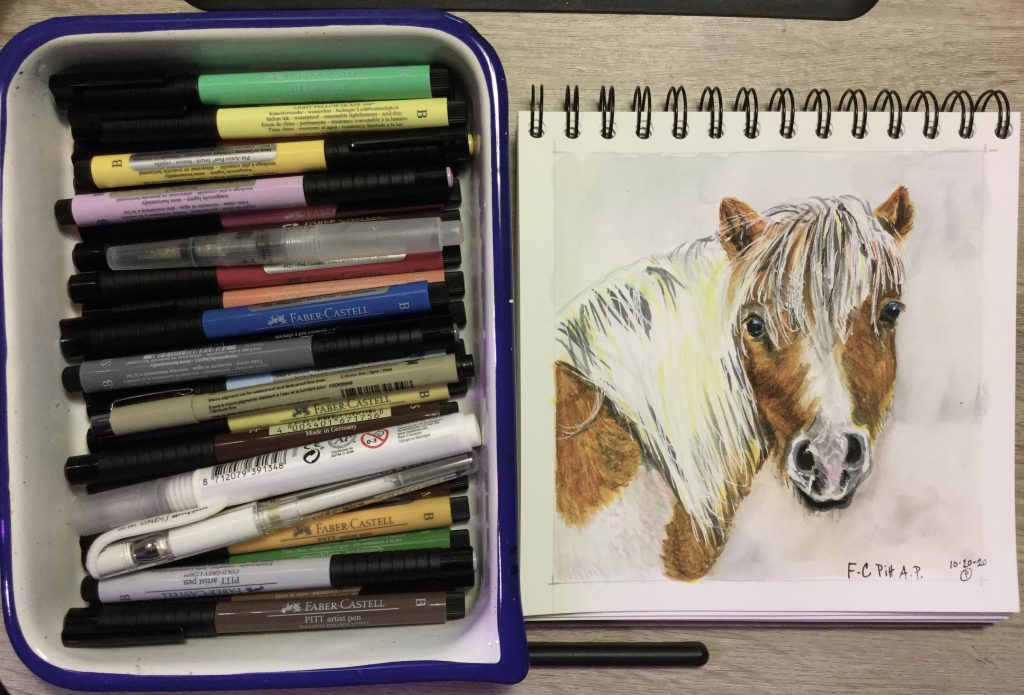
I think it creates beautiful, glowing colors. Unlike watercolor, I don’t overmix and create mud. I wanted to add a little opacity as well as some white here and there, however, so I bought a bottle of Dr. Martins’s Bombay white. That, along with the few dozen Faber-Castell Pitt Brush Pens should hold me for awhile.
I sketched this pony very quickly and liked it so much that I completed the larger one above the next night. The second one is more true to the photo I took.
I’ve learned to work from light to dark as once the ink is down, it’s not possible to lift it unless working on a surface like Claybord or Duralar. I’ve also learned to use washes and glazes. I don’t quite know how such an art supply fiend like me has managed to miss ink as a medium all these years. I’m pleased I finally found it.